
Is androgenetic alopecia serious? How can I stop androgenetic alopecia for good? I’m worried I’ll go completely bald when I reach the menopause – how can I prevent that?
Behind these questions about baldness, what we see above all is the expression of fears about hair loss that seems abnormal.
For decades, the specialists at Clauderer have been supporting men and women concerned about hair loss, and these questions often come up during the initial diagnostic appointment.
Here, we’re offering you a chance to get back to basics with 10 questions on androgenetic alopecia, because understanding is the first step towards taking action.
Androgenetic alopecia: what is it?
Let’s start with a simple definition1 androgenetic alopecia, whether male-pattern or female-pattern: it is the scalp’s susceptibility – and the scalp’s alone – to the damaging effects of an enzyme produced by male hormones, or androgens. This enzyme, 5-alpha reductase, produces dihydrotestosterone, or DHT. This very powerful hormone causes the hair follicles to weaken. The hair growth cycle This disrupts the hair growth cycle, and the proportion of hair in the telogen phase (end of the growth cycle) increases. As a result, the hair renewal cycle speeds up and the hair no longer grows back as well; it gradually weakens and becomes finer. Eventually, the hair follicle wears out prematurely and the hair supply dries up too soon. Thinning patches appear on the scalp and, when the follicle no longer produces any hair, completely bald patches become visible: this is baldness. If left untreated, the process is irreversible.

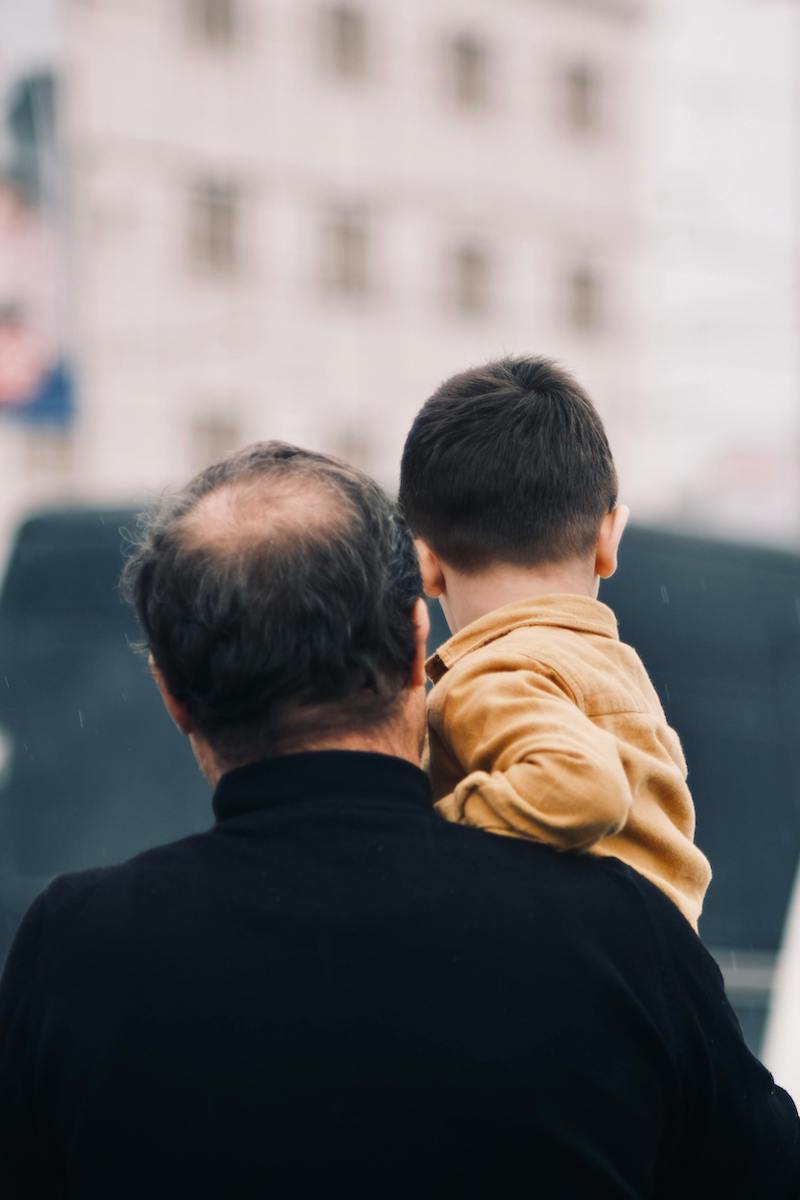
Deepening receding hairlines and a pronounced crown, characteristic of male pattern baldness
Androgenetic alopecia: 10 key questions
- “Is androgenetic alopecia a medical condition?” No, Androgenetic alopecia is not a disease. It’s a malfunction, or a stroke of bad luck, if you like. Just as you inherit your eye colour and hair colour, you inherit a tendency towards baldness … or you don’t. It’s a question of genetic predisposition.
- “If it’s hereditary, why am I the only one in the family who’s bald?” It’s a logical question, but the reality is more complex. As men naturally produce more male hormones, they are proportionally more likely than women to have a scalp that is sensitive to DHT. However, not all men go bald, and varying degrees of hair loss can occur amongst siblings. Furthermore, stress, medication, lifestyle, the environment and so on are all additional external factors that can exacerbate the condition.

Hair loss can affect siblings in different ways
- “What about female androgenetic alopecia?” Female hair loss This is, of course, also down to this hereditary factor, but female hormones protect the hair follicles from the effects of DHT. That is why:
- In women, the areas of hair loss are smaller and occur in different places. Hair loss is often diffuse and gradual.
- A woman is never completely bald – except in cases of an autoimmune condition such as alopecia areata or following intensive medical treatment – but excessive thinning can lead to a loss of density, thinning at the temples and a widening centre parting
- The hormonal changes that occur throughout a woman’s life (such as pregnancy or the menopause) can be triggers for female androgenetic alopecia.
- “I’m going bald because I have too much testosterone”: no, male or female androgenetic alopecia is not caused by the level of male hormones. Testosterone is one of these male hormones, secreted mainly by the testicles in men and by the ovaries in women (in small quantities), but also by the adrenal glands in both sexes. It is the production of DHT – an enzyme actually secreted from testosterone depending on a genetic “lottery” – that is the key factor. This is why a woman may be born with a genetic predisposition to baldness; indeed, this accounts for 80 % of female hair loss.2.
- “Androgenetic alopecia is a hormonal condition”: no, not at all. It is not a condition, nor is it a hormonal condition, even though hormones play a major role in triggering hair loss. To put it simply, in men, androgens – and therefore DHT – are produced mainly via testosterone. In women, androgens are produced in small quantities by the ovaries and the adrenal glands.
- Androgenetic alopecia is not a hormonal condition, but … hormones play a major role! Just think of the hormonal surges a woman may experience during pregnancy, childbirth and then the menopause, …all these factors have a significant impact on the proper functioning of the hair follicles and, consequently, on hair growth.

Menopause, a common trigger of androgenetic alopecia in women
- “How can androgenetic hair loss be stopped?”: unfortunately, there’s no miracle cure! It’s impossible to simply stop androgenetic hair loss altogether. Why? Because we cannot change characteristics as intrinsic as our genetic makeup. That’s the bad news. But the good news is that we can still take steps to slow down its effects. You can start by having a consultation with a hair specialist, then identify any imbalances, and finally address the external factors that accelerate hair loss (highly processed foods, chronic stress, nutritional deficiencies, unsuitable contraception). Next, adopt a simple and effective hair care routine using natural products to stimulate hair follicle activity and promote the growth of healthier hair.
- “I’m taking dietary supplements, but my hair is still falling out.” If this is a temporary dip in form linked to seasonal hair loss or temporary fatigue, then taking food supplements specially designed to answer hair issues. When correctly dosed for the hair, these can provide valuable support. We select B-group vitamins, sulphur-containing amino acids essential for hair vitality – such as methionine and cysteine – as well as iron and zinc, all in sufficient quantities to ensure genuine effectiveness. If hair loss persists for more than 8–10 weeks, topical treatments aimed at reactivating the hair follicle should be considered. At the same time, a blood test can identify any deficiencies in iron or vitamin D, or a thyroid imbalance.
- “A hair transplant stops hair loss”: a hair transplant permanently restores hair to areas affected by baldness, such as the crown or the frontal area, but the androgenetic process continues inexorably in the areas not treated. In men, it is estimated that hair loss peaks around the age of 35–40; this is the age at which one can reasonably consider a hair transplant. It is best to remain vigilant and continue to look after the original donor area in case a further transplant becomes necessary. Do not start too young, as this risks depleting the donor area prematurely and leaving you too thin-haired for further hair transplants. In the event of early-onset baldness at the age of 20 or 25, it is better to begin a localised, targeted preventative treatment than to undergo extensive hair restoration.
- “I started a Clauderer treatment two weeks ago and my hair is still falling out!” Unfortunately, this is normal, even if it is frustrating. Slowing down hair loss takes time, whatever the cause. It takes about four months for a hair to reach the scalp. The longer you’ve been losing hair, the more worn out your hair follicles are and the harder it will be for hair to grow back. Cell renewal isn’t as active at 60 as it is at 35, so it’s best to start looking after your hair as soon as possible. Aggravating factors such as stress or chronic anaemia can also slow down the hair regrowth process. In short, patience and consistency are the key to a successful hair loss treatment programme.
At present, there is no miracle cure for hereditary hair loss. However, there are effective treatments available to slow down its progression, whether you are a woman or a man. The earlier you take action, the better the results will be. Understanding what happens in cases of androgenetic alopecia means making informed decisions and choosing the right treatment strategy. Regaining control over your hair loss means looking after yourself and feeling confident in your own hair. To find out more, come and meet our specialists!

To slow down the effects of hair loss, it is vital not to wait

Jean-François Cabos is the creator of a unique hair care method based on the research he coordinated, which led to the publication of the book Hair, Roots of Life with Hélène Clauderer published by Robert Laffont (Collection "Réponses/ Santé").

