
Dull, limp hair, frizz, curls that lose their elasticity, fragile hair that breaks easily? What if it was hygral fatigue? The term is still little known, but that doesn't mean the phenomenon doesn't exist. Hygral fatigue simply means too much moisture.
To understand how hygral fatigue occurs and what impact it has on the hair, we first need to take a look at the basics of hair structure. This will help us to understand which gestures should be avoided and, above all, what we need to do to restore the right amount of moisture to our hair - whatever our hair type (straight, soft, curly or very frizzy) - for shiny, toned lengths, in short, hair that breathes health!
Hair structure
To understand how hair becomes hygrally fatigued, we need to consider a hair as a series of superimposed layers of cells that form a solid yet elastic fibre of exceptional strength. The heart of the hair is the medulla, covered by a thicker layer, the cortex, which is in turn covered by a thin layer of interlocking scales: the cuticle, whose role is to protect the hair shaft from external aggression by forming an impermeable barrier.
What about the hair shaft? The hair shaft - the hair - is essentially made up of keratin (i.e. proteins) and also contains water, lipids (sebum), minerals and trace elements, as well as the pigments that give hair its colour.
Recognising the signs of hygral fatigue
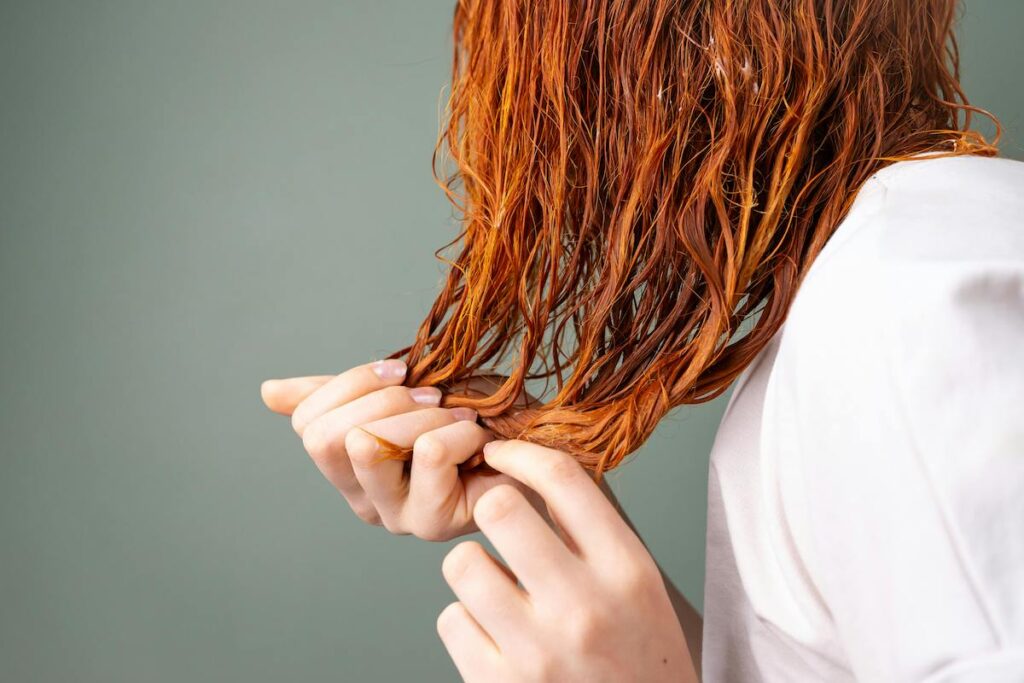
Etymologically, 'hygral' comes from the Greek 'hugro', meaning water. Hygral fatigue is the result of excessive water intake: hair is sprayed with water several times a day even before it is completely dry, and overly rich treatments are applied that are ill-suited to the hair's needs. The result: the fibre fills up with water (a bit like a balloon), then 'empties', then fills up again with more water - it's never-ending. In the long run, overworked, the fibre no longer reacts: it is exhausted by these incessant demands, the cuticle is damaged, the scales remain open and the hair becomes increasingly porous: this is hygral fatigue. If we often associate hygral fatigue with afro, curly or frizzy hair, it's because this type of hair is generally recognised as being particularly dry, even dehydrated by nature. What's more, hair routines for textured hair are full of products designed to 'boost hydration', with moisturising balms, spring water sprays and oil baths. But despite this kind of assiduous ritual, you find that the quality of your frizzy, curly hair isn't improving - quite the contrary. Your hair loses its natural shine, the curls are no longer as defined, the hair seems even more fragile, it's frothy, it breaks, it's no longer as soft and even seems to have changed texture. Worse still, all these treatments seem ineffective, as if they've reached a plateau and even produce the opposite effect to what you were expecting. Hair feels saturated, it doesn't absorb products like it used to. Afro hair may be more susceptible to hygral fatigue than other hair types, but that doesn't mean that other hair types aren't likely to suffer. Too many unsuitable, over-rich, over-chemical or over-frequent hair care products, or incorrectly applied and rinsed, can weaken and exhaust the hair fibre, whatever the hair type!

Hygral fatigue: beware of overdose!
Avoiding hygral fatigue
As is often the case, restoring and maintaining the right level of hydration and thus preventing your hair from becoming hygrally tired is a question of common sense and taking the right steps to ensure that your hair is shiny, sufficiently nourished and full of strength.
5 tips to combat hygral fatigue :
- Choosing the right cleanser. Choosing the right shampoo for your scalp (normal, oily, irritated or sensitive) and hair type (Caucasian, mixed-race or very curly) is not as easy as it sounds. Here are a few recommendations to help you make of your shampoo a genuine hair care product: choose gentle, natural ingredients, a plant-based cleansing base that won't damage the hair fibre, ingredients targeted to your needs: soothing, moisturising, restructuring, etc.
- Shampooing: the right rhythm. Avoid "stripping" the hair fibre by washing your hair every day if you don't have to. Afro hair can go without shampooing for 2 weeks, but this is more frequent for Caucasian hair, which can tend to become greasy quickly. In this case, you can opt for the following combination: purifying hair milk and gentle shampoo, to balance out the greasiness. the pH of the scalp and wash without stripping.
- Moisturise without overloading: rinse-off cream or mask, choose the texture according to the hair: a light texture, such as a fluid cream or jelly, if the hair is fine, a rich, nourishing texture if the hair is normal to thick and very dry. Respect any application times to allow the active ingredients to work. What about oil baths? Always use caution! Choose a hair care product with a good quality vegetable oil, such as jojoba, argan or castor oil. This oil is renowned for its many benefits. Beware of coconut oil, which can cause the hair fibre to dry out more if used in excess.
- Drying: gently. If possible, let your hair air dry, or at least towel dry as much as possible. If necessary, apply a serum or dry oil to the lengths to make styling easier and add shine. Here again, be careful not to overdose: a dab spread throughout the hair is usually enough to add shine and silkiness.
- Heated tools and cosmetic manipulations: respect the hair fibre by spacing out straightening and other techniques that destroy the cuticle and leave the hair scales open, making it porous and permeable. Straightening irons, curling irons or hairdryers: yes, but not too often, not too hot, otherwise there's a major risk of damaging the hair fibre for good. Open scales, split ends: no amount of repair care will do and the only remedy is to cut!

The right care, the right quantity, quality hair products and your hair will be radiantly healthy!
Hygral fatigue affects all hair types. It's a slow, gradual and often insidious process, because we think we're doing the right thing by intensely moisturising our lengths. But hair that has been damaged and weakened by cosmetic manipulation or inappropriate care will be weakened even further by excess hydration: hair is alive, and it deserves a routine that is adapted, gentle and respectful of its particular characteristics. All it takes is a little attention to know and recognise the warning signs your hair is sending out: there are times when it needs help when it becomes dull, brittle and no longer 'responds' as well as it used to to the care you give it. And there are times when it's best to let your hair breathe by putting - part of - your hair routine on hold. In reality, with the right gestures and just the right amount of hair care, your hair can become your most beautiful asset, naturally.
Jean-François Cabos is the creator of a unique hair care method based on the research he coordinated, which led to the publication of the book Hair, Roots of Life with Hélène Clauderer published by Robert Laffont (Collection "Réponses/ Santé").
