

Hair loss is a phenomenon that preoccupies - even anguishes - both women and men, and can affect us as early as teen age years, and whatever our hair type. There's obviously a difference between losing a few hairs and finding masses of dead hair in your towel after shampooing or on your brush every day. When hair loss is a cause for concern, it's easy to lose all objectivity and see yourself as bald or almost bald in the near future!
At Clauderer, our specialists often hear from customers who are stressed about their hair loss. The hair falls out too much, in handfuls, on clothes, the pillow or in the shower. It's a frightening situation, of course, but it doesn't necessarily reflect reality. There is another reality: hair doesn't fall out too much, but it does break.
Here, we're going to look at the difference between hair loss and hair breakage, two common situations that have very different causes and consequences.
These two phenomena are distinct but, unfortunately, they can combine.
How can you tell the difference between hair loss and breakage?
A hair that falls out is a complete hair, comprising the root (the bulb) and the shaft. If you don't feel this little ball, or at least a slight bulge, at one end of your hair, it's probably not falling out but breaking. A hair breaks before the bulb, it is not at the end of its life but still very much alive, anchored to its hair follicle, only a piece - more or less long - has become detached.
Illustration:
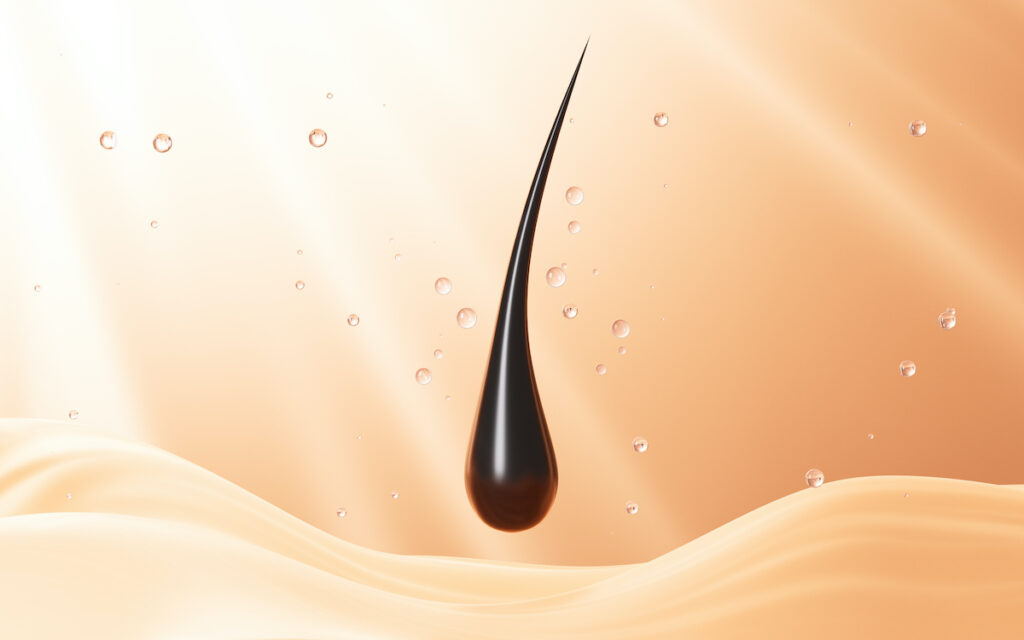
Hair that falls out always has its root. In this case, the hair has fallen out at the natural end of its life cycle and the root is strong and shapely. A hair that falls out prematurely has a weakened root, lacking strength and irrigation. Its calibre is then too fine to ensure the hair's lasting anchoring.
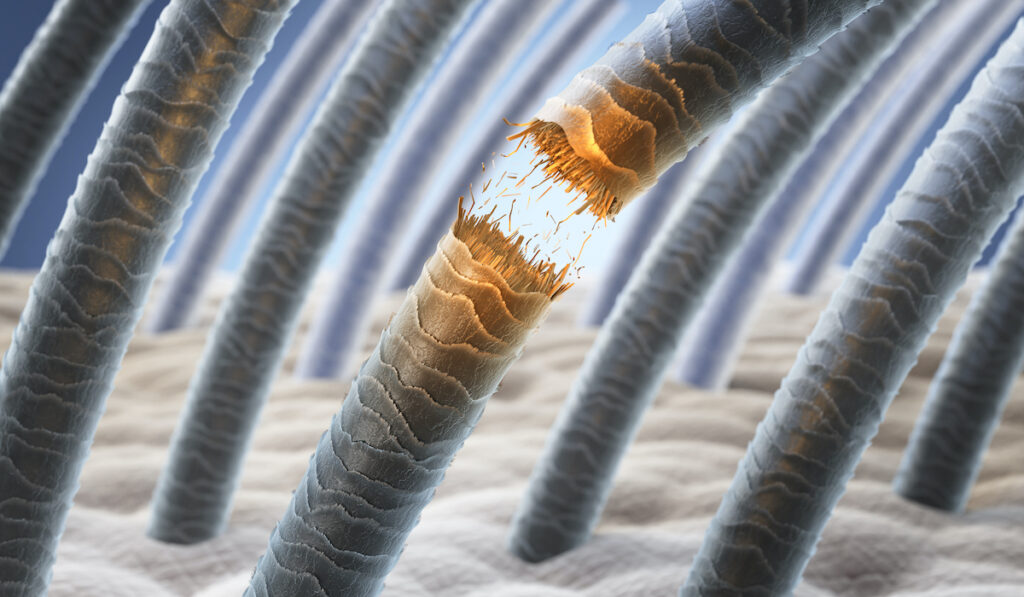
A hair that breaks is rootless. It is a piece torn from the shaft, the keratin is shattered and the fibre damaged. The hair loses its strength and breaks.
What are the main causes of hair loss?
First of all, an important point: losing hair every day is completely normal. In fact, you can lose anywhere from a few hairs a day to a hundred or so without any cause for concern. What's important is the renewal capacity of the hair cycles. If you lose 50 hairs and 50 of the same quality grow back, everything's fine and your hair density doesn't change. But when 10 hairs fall out and only 5 grow back, it's imperative to be concerned, as this is the sign of a progressive deterioration of the hair's capital.
Some of the main causes of hair loss are temporary, while others require more attention because hair loss will not resolve itself:
- Seasonal hair loss, which occurs mainly in autumn and spring, is generally benign.
- Drug treatments: hair loss can be massive and diffuse (telogen effluvium) but stops when the drug is stopped.
- Post-partum hair loss: linked to the hormonal changes experienced during pregnancy, this occasional hair loss can be delayed by a few months if you are breast-feeding your baby.
- Deficiencies: sometimes difficult to identify and slow to correct, such as iron-deficiency anaemia, which can require blood transfusions and months of recovery.
- In women as in men, androgenetic alopecia is due to the receptivity of hair follicles to the enzyme called DHT secreted by male hormones. It is inevitable, but not without a solution.
- In women, hormonal changes mark the different stages of biological life and can affect hair health: puberty, pregnancy (if any), the menopause. If aggravating factors such as stress, unsuitable contraception and deficiencies are involved, watch out!
- Thyroid: A thyroid dysfunction can lead to hair problems and should be a cause for alarm. If you notice that your hair is more brittle, duller, softer or rougher - in short, that it changes texture - this may indicate a thyroid imbalance.
- Autoimmune diseases such as total or partial alopecia.

Seasonal hair loss and androgenetic male alopecia have different causes and different consequences

What should I do if my hair falls out too much?
You can start by giving them a boost with a course of food supplements specially designed to answer hair issues. This means they are rich in B vitamins, minerals and amino acids.
Vary your diet, giving priority to fresh fruit and vegetables and quality proteins.
If hair loss persists, a blood test will identify possible deficiencies and imbalances. Various solutions will then be possible.
At Clauderer, after diagnosis, we will suggest a natural and effective treatment programme to stimulate your hair follicles and encourage healthier hair growth.
What about breakage?
It's not uncommon to confuse hair breakage with hair loss, even though these are two different realities. One can exist without the other and, unfortunately, both can accumulate.
Hair that breaks is hair that is weakened. In an ideal world, hair has a particularly solid and resistant structure with incredible elastic properties.
In the real world, things are often very different.
Why does hair break?
- Hair type: Afro, curly and frizzy hair is particularly prone to breakage. The main cause is curls! Each curl is a breaking point for the famous disulphide bridges that hold the hair fibre together. The more curl, the more danger, but straight, Caucasian hair is not spared from breakage.
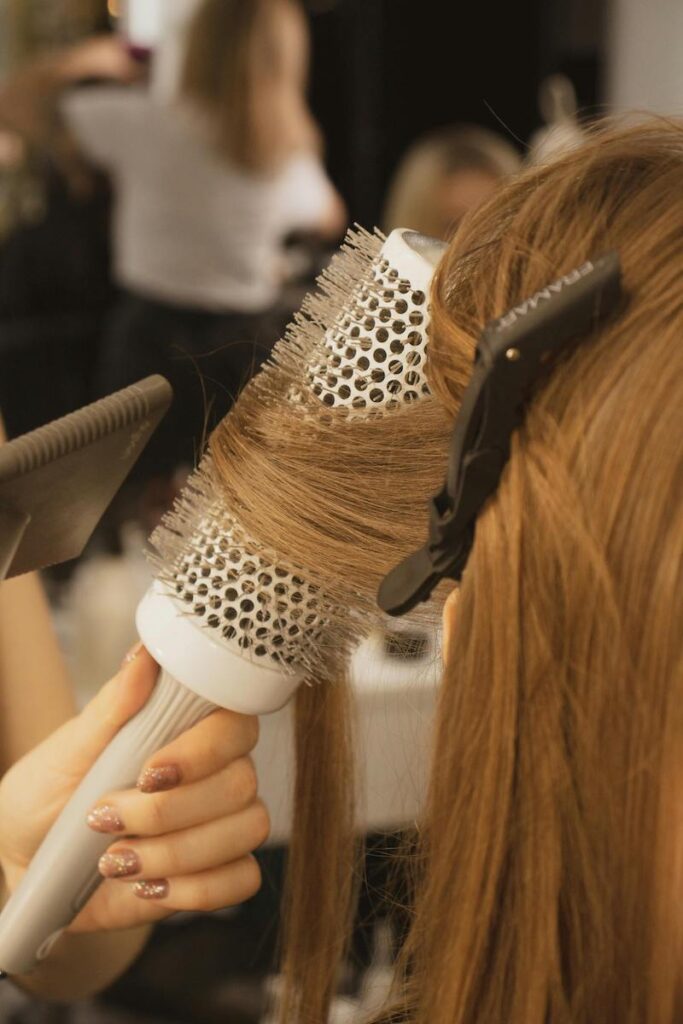
- Cosmetic manipulations: straightening irons, tight hairstyles held in place with elastics, straightening, hot tools too close to the hair, or repeated chemical colours damage the cuticle and the hair cannot resist. It crumbles, splits, falls out in pieces and the ends split. Cosmetic manipulations affect all hair types.
- Unsuitable hair routine or no routine at all! too rich, too chemical, pollution, insufficient hydration, brushing using the wrong tools (plastic combs vs. horn or wood),...

Fragile curly hair, inappropriate cosmetic handling: beware of breakage!
What can be done to repair brittle hair?
When hair breaks, it's a sign of deep, long-term damage. Insufficiently moisturised, malnourished and mistreated, it no longer "responds".
In the most serious cases, the only solution is to cut off a few centimetres, or even more depending on the case, to get back on a healthy footing with a hair routine adapted to the nature and type of hair. If the damage can still be repaired, moisturise with sprays enriched with vegetable oil (for afro hair), nourish the keratin with textures suited to your hair, favouring plant butters or complete treatments based on jojoba oil or shea butter and vitamins beneficial to the hair. Space out the colours as much as possible and leave to dry in the open air or with a hairdryer on low setting.

Looking good, feeling good!
Hair that falls out too much and hair that breaks are signs that your hair is in bad shape. Knowing the difference between these two phenomena - which sometimes, but not always, occur together - is essential if you want to determine the most effective hair care routine for repairing and protecting your hair. Because your hair reflects who you are, it's worth taking a little time to look after it, isn't it?
Jean-François Cabos is the creator of a unique hair care method based on the research he coordinated, which led to the publication of the book Hair, Roots of Life with Hélène Clauderer published by Robert Laffont (Collection "Réponses/ Santé").
